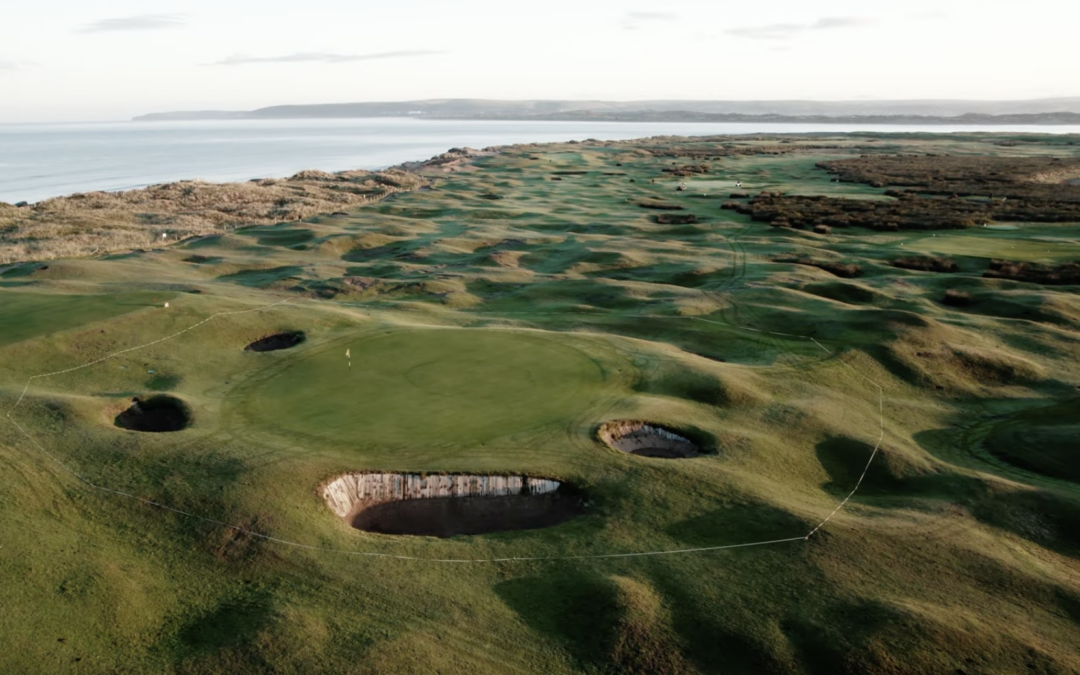
There are few places in England where the story of golf feels quite so alive as it does at Royal North Devon. Set on the wild, wind-brushed expanse of Northam Burrows, the game first took root here in the 1850s, when a visionary local clergyman, Reverend Isaac Gosset, returned from St Andrews inspired to introduce this curious Scottish pastime to southern shores.
What began as informal play across common grazing land soon gathered momentum, and by 1864 the North Devon and West of England Golf Club was formally established—making it the oldest golf course in the country. Old Tom Morris himself laid out the original links, shaping little more than routing across the natural terrain, allowing the land, the sea, and the ever-present breeze to dictate the challenge. In 1867, It became a ‘Royal” club after patronage from King Edward VII.
Over time, storms reshaped the land, the course evolved, but the essence never changed. Today, Royal North Devon remains a living relic of golf’s golden age: a place where the rhythms of the past still echo across firm-running fairways, and where every round feels like stepping into the very origins of the game itself.
Who Was Old Tom Morris?
Few figures loom larger over the history of golf than Old Tom Morris. Born in St Andrews in 1821, he was far more than simply a champion golfer; he was one of the true architects of the modern game. A four-time Open Champion, pioneering greenkeeper, club maker, course designer, and mentor to generations of players, Morris helped shape golf at a time when the sport was still finding its identity. His influence stretched far beyond competition, transforming the way courses were maintained and played. Many of the principles he introduced—separated teeing grounds, improved drainage, strategic bunkering, and carefully tended greens—remain fundamental to golf course architecture today.
Yet what made Old Tom truly remarkable was the philosophy behind his work. He believed golf courses should emerge naturally from the land rather than overpower it, embracing the contours, winds, and unpredictability of the landscape. That thinking can still be felt across many of the great links courses he touched, where strategy and imagination matter more than brute force. Royal North Devon is one of the best examples on this philosophy.
First Impressions and Getting Started
The course unfolds as a par 72 stretching 6,765 yards from the white tees—the chosen set for the day—offering a true test of distance, control, and adaptability in ever-changing conditions.
What strikes you immediately from the 1st tee is just how raw and natural the landscape feels. There are no sharply defined edges separating fairway from rough, no immaculate cross-cut mowing patterns designed for presentation or spectacle. Instead, the course rises organically from the land itself, untamed and wonderfully authentic, as though it has simply always existed here.
The fairways blend seamlessly into the surrounding terrain, shaped more by wind, weather, and time than by machinery. Nothing feels manufactured. Nothing feels forced. It is links golf in its purest form—rugged, exposed, and gloriously indifferent to modern expectations of perfection.
And that naturalism changes the way you see every shot. Targets appear less obvious, landing areas less certain, and the ground becomes as important as the air. It’s a course that asks you to embrace unpredictability rather than fight it, rewarding imagination and acceptance over rigid precision.
Eighty Yards of Fear
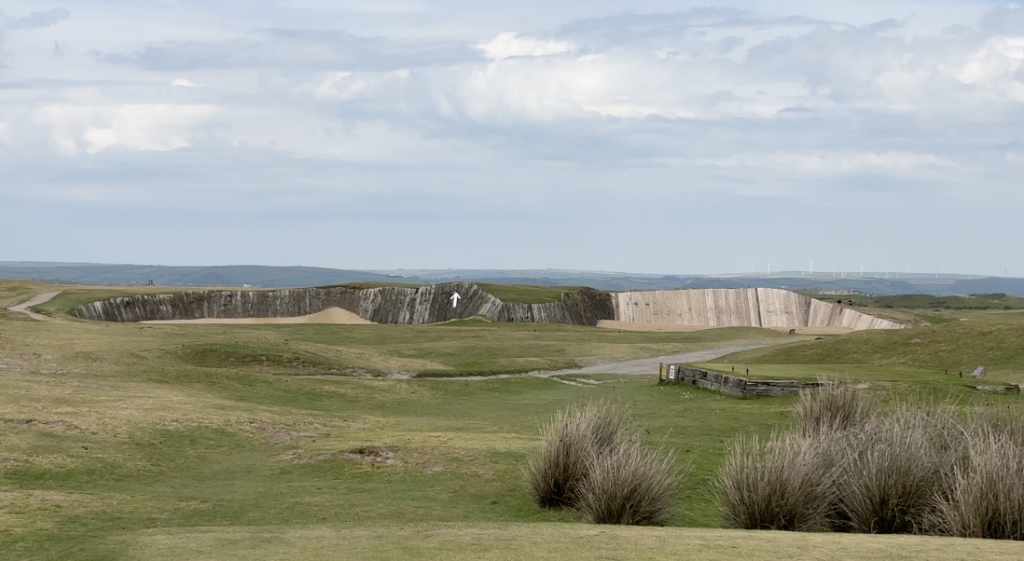
The Cape Bunker on the 4th hole
They aren’t random bunkers, nor relics of some forgotten military defence. What rises ahead on the 4th hole at Royal North Devon is one of the most iconic and intimidating hazards in golf: the legendary “Cape” bunker.
Stretching almost 80 yards across the line of play, this enormous cross-bunker cuts through the hole with startling authority. Its towering wooden sleepers form near-vertical walls, giving it the appearance of an old quarry or wartime trench carved brutally into the landscape. From the tee, it dominates both the eye and the mind. The carry is entirely manageable in reality, yet the visual intimidation it creates is extraordinary. For a brief moment, it feels impossible.
Challenge it boldly and the hole opens up invitingly beyond, rewarding courage and commitment. Hesitate, however, or choose caution, and you are left with a far more demanding route to the green. Its timber face—reportedly constructed using old pier wood—only adds to its raw, weathered character. And should your ball disappear into its depths, escape becomes survival rather than recovery. Advancing toward the green is often unrealistic; sideways or backwards is usually the wiser option. Despite the visual intimidation of the tee shot, hit it solidly and this hole present a birdie opportunity.
J.H. Taylor
When you walk off the green at the 4th and head to the 5th tee, you are faced with another nod to the history of Royal North Devon Golf Club. There is what is best described as a mural of J.H.Taylor, a famous son of this area of North Devon. Who was he?

J.H. Taylor was one of the defining figures of golf’s formative years and a man whose influence extended far beyond his five Open Championship victories. Born in 1871, Taylor emerged from humble beginnings to become one of the sport’s first true professionals, forming part of the legendary “Great Triumvirate” alongside Harry Vardon and James Braid.
Renowned for his strategic mind and exceptional control in difficult conditions, he helped elevate competitive golf to a new level during the late 19th and early 20th centuries. Away from tournament golf, Taylor also left a lasting mark as a prolific course designer, believing that great courses should challenge a player’s judgement as much as their technique. His architectural work reflected a deep understanding of natural terrain and strategic positioning—principles that continue to influence classic golf course design to this day.
Eight Bunkers
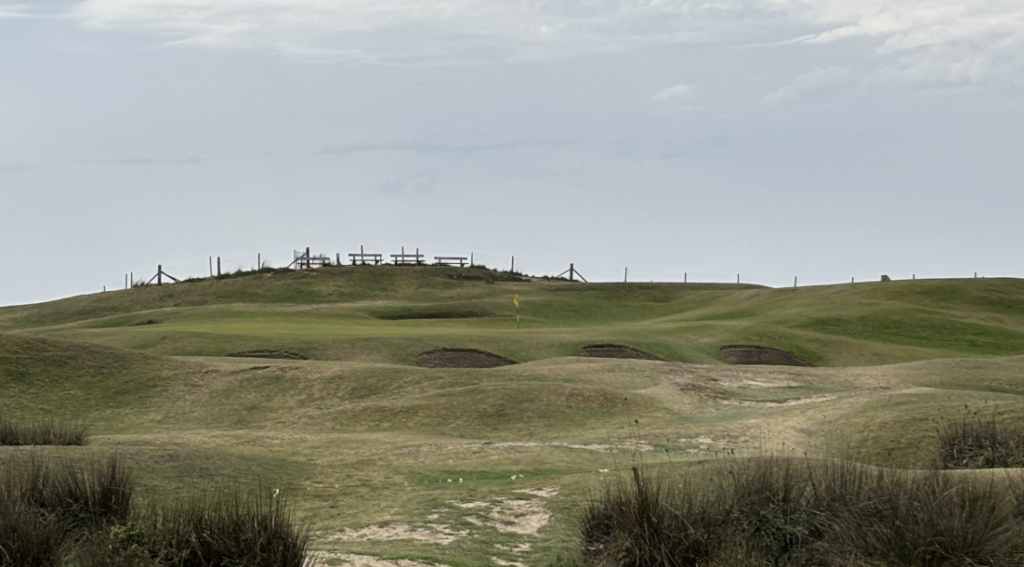
The green on ‘Table’, the 5th
At just 138 yards, the 5th appears—on paper at least—to be the definition of a scoring opportunity. A simple wedge, a quick birdie chance, a brief pause in the test ahead. But the reality is far more demanding. The green itself is fiercely defended—ringed by no fewer than eight bunkers that seem to close in from every angle. There’s no easy side, no generous bailout, just a target that demands both precision and commitment in equal measure.
Par here is never routine. It’s earned through careful judgement, disciplined execution, and a willingness to accept that what you see is not always what you get. And if you manage it, you don’t just walk off with a good score—you step onto the 6th tee properly prepared for what is widely regarded as the toughest hole on the course.
The Hardest Hole
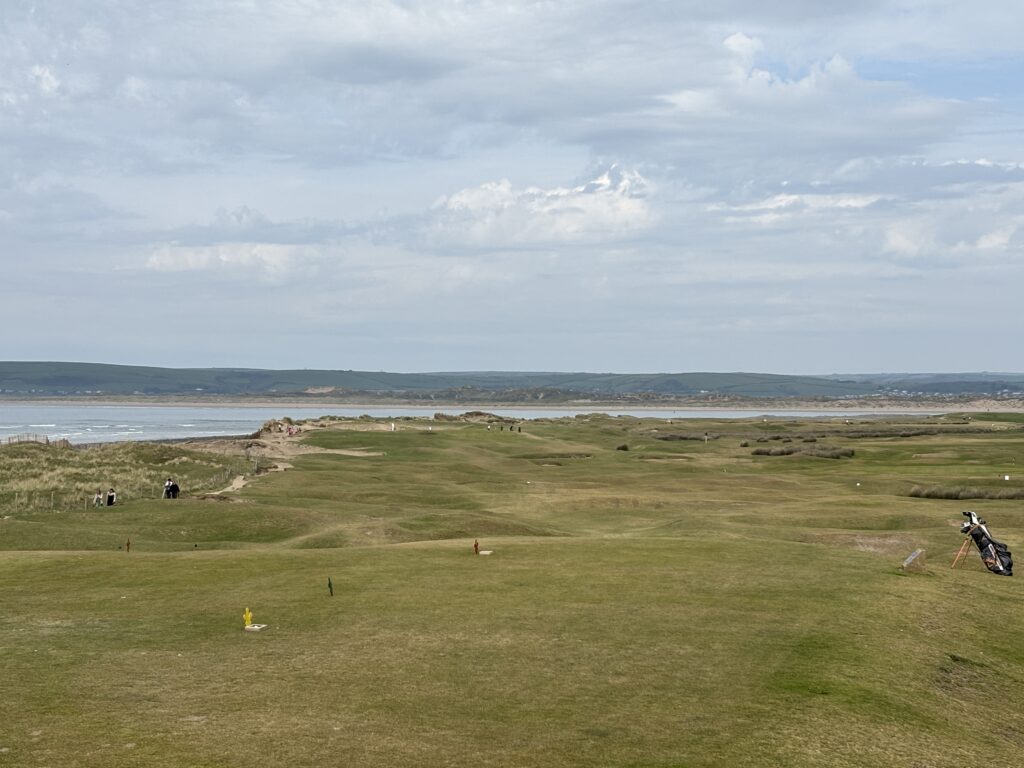
The tough 6th hole, Alp
At 411 yards, the 6th hole doesn’t rely on brute length to make its point—it relies on precision, patience, and the uncomfortable feeling that there is danger waiting almost everywhere you look from the tee. Five bunkers are staggered through the landing area, not as decoration but as deliberate interruptions to rhythm, each one positioned to catch the slightly wayward or the fractionally over-ambitious. The challenge is not simply to avoid them, but to commit fully to a line that threads through them with conviction.
Find the gap and you’re rewarded with a mid-iron approach of around 160–170 yards into a long, narrow green that demands absolute accuracy. The real penalty, however, is not just in the bunkering off the tee but in the putting surface itself. There is no safe miss to the right—anything drifting that way is quickly lost to trouble—and even a well-struck approach offers no guarantees. The green is subtly contoured, full of quiet undulations that can turn a solid shot into a delicate two-putt challenge in an instant. Pars here are earned, never assumed.
The Back Nine: Avoid the Rushes
Before you even reach the 1st tee, the course offers a quiet but very real warning. Around the clubhouse and pro shop, signs point out the presence of rushes scattered throughout the layout—natural, untamed, and far more punishing than they first appear.
If you’re tempted to play in shorts, take it from experience: think twice. These aren’t soft, forgiving grasses. The fronds are wiry and razor-sharp, and even the slightest brush against them can leave your legs stinging. It’s the kind of damage you don’t fully notice until later—when the round is done and the evidence quietly reveals itself.
Out on the back nine, they come into play more frequently, framing holes and tightening landing areas in ways that demand both discipline and respect. Venture too far offline and the consequences are immediate. A ball lost in the rushes is, for all practical purposes, gone. And the idea of rummaging around to find it? Best abandoned quickly. This is not the place for half-hearted searches or hopeful prods with a club—you’ll come away with far more than just a lost ball.
It’s all part of the course’s raw, natural character. Beautiful to look at from a distance, but up close, it reminds you that this landscape plays by its own rules.
Through the Rushes: The Course’s Most Deceptive Par 3
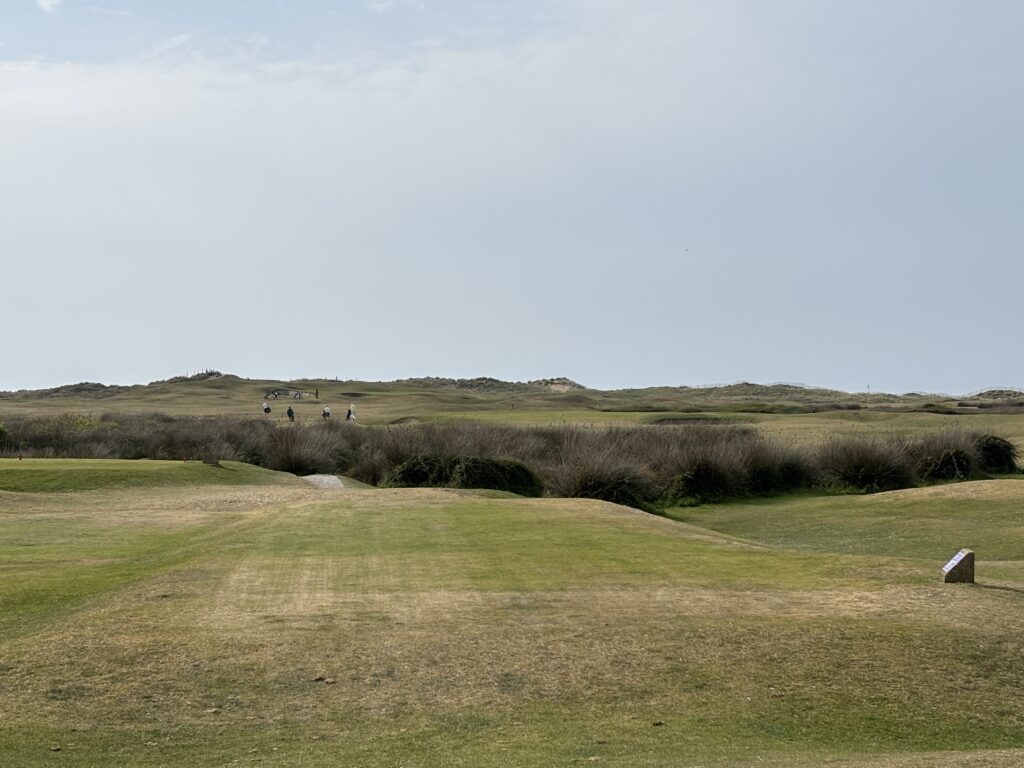
The 14th hole
At 207 yards, the 14th stands as the longest par 3 on the course. From the tee, the view is partially veiled by encroaching rushes, creating the impression that the carry must be absolute, every yard flown cleanly to the green. It’s an intimidating picture, one that can easily plant doubt before the swing is even made.
But the reality is more nuanced. The rushes fall away well short of the putting surface, leaving room for a properly struck shot to land safely—if you trust what lies beyond what you can see. That uncertainty is only heightened by the bunkering, cleverly concealed until it’s too late. Five bunkers guard the green, three clustered on the left, ready to gather anything drifting even slightly off line.
It’s a hole that tests both nerve and clarity. Club selection becomes a matter of conviction, not just distance, and hesitation is rarely rewarded. Walk away with a par here and it feels like a small victory. One earned through trust, execution, and a willingness to see beyond the illusion laid out in front of you.
No Room for Error

The 16th hole where rushes are plentiful
This is a superbly crafted par 3—visually inviting at first glance, yet quietly exacting in everything it demands. The green is beautifully defended and tilts noticeably from left to right. Distance control is everything here. Come up short and the consequences are immediate. A swale at the front has a habit of killing momentum, nudging the ball down into the deep bunker that lurks below. It’s the kind of miss that turns a routine par attempt into a delicate recovery.
But there’s no safety long, either. Push it beyond the target and another cavernous bunker waits to collect anything overhit. The margin for error is narrow, and accuracy isn’t just preferred—it’s essential. It’s a hole that rewards commitment and precision in equal measure. Strike it well, hold the green, and you’ll walk away with a deserved sense of satisfaction. Miss your number, however, and it quickly reminds you just how finely balanced the challenge really is.
The Setting: Shared Ground

My wife making a new friend
A big part of Royal North Devon is where it sits. You’re not on a closed-off piece of land. This is common ground, and it feels like it. People walk across it, sheep graze on it, and the wild ponies are part of the place. It might sound like a distraction, but it actually adds to it. It reminds you that the course isn’t in charge here. It’s just part of the landscape. And the landscape itself changes constantly. The wind shifts, the ground firms up or softens, and no two rounds feel quite the same.
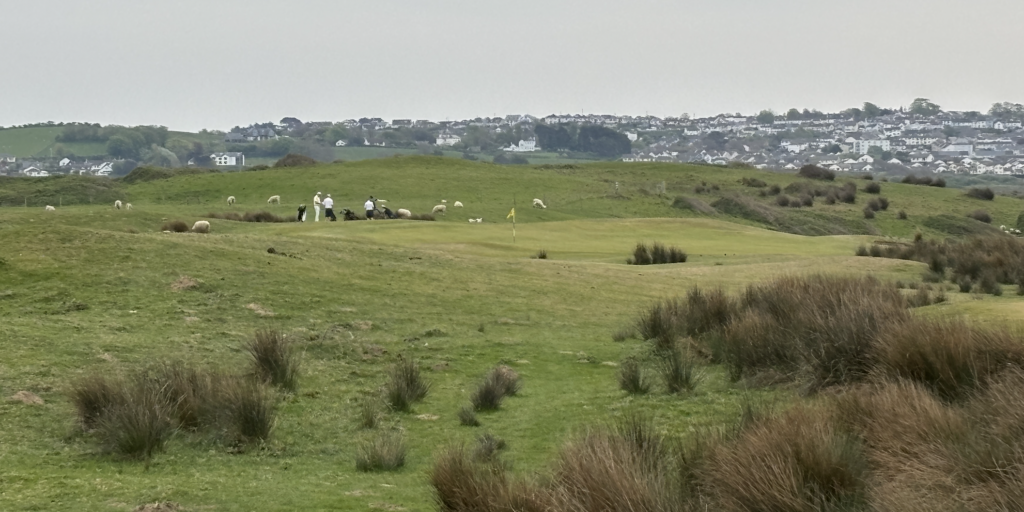
Sheep “cutting” the grass
What Stays With You
There isn’t a single signature hole here—the kind you walk off replaying in your mind or rushing to describe. But that’s entirely the point. This is not a place defined by one moment. It’s shaped by a feeling that builds, lingers, and quietly takes hold over the course of the round.
What stays with you is the atmosphere of it all. The way the ball skims and releases across the firm turf, chasing contours you didn’t fully anticipate. The wind is never a constant—more a restless presence, shifting, nudging, second-guessing your decisions. Even when you’re striking it well, there’s a sense that control is only ever partial, borrowed rather than owned.
But that’s the beauty of it. Whether you play well or not, it never lets go of your attention. It draws you in, keeps you engaged. And long after the round is over, it’s the experience—not a single hole—that stays with you.
Final Thoughts
Royal North Devon isn’t a course you conquer. You don’t walk off feeling like you’ve figured it out. If anything, you feel like you’ve just about managed it for the day. But you do walk off remembering it.
The wind, the ground, the openness of it all—it stays with you. Not in a dramatic way, just in the back of your mind. And that’s probably why people keep coming back. Not because it flatters you. But because it feels like real golf.
Thank You

Young Harvey and Old Jim
I would like to take this opportunity to thank 17 year old Harvey Williams, a junior member who joined us on our wander around Royal North Devon. Despite only playing golf for two years, Harvey guided me around the links like a pro and kept me out of trouble. An unfailingly polite young man, he was a credit to both the club and his family. Harvey, I wish you every success in the years to come, both in golf and your chosen career. Thank you, it was our pleasure.
Summary
- The oldest links course in England
- Historical museum within the clubhouse
- 27 holes, 18 Championship Links and 9 hole par 3 course
- Three time host of the British Amateur
- Short game practice area and putting greens
- 2 hour drive from Bristol, 4 hours from London
- Visit The Royal North Devon Golf Club website

Jim Callaghan CCM is a former Club Manager with experience of overseeing several top Scottish Golf Clubs.
Now, as European Editor of Golf Operator Magazine and World’s Best Golf Destinations, he shares insights into club operations and his golfing adventures across Europe.
Jim is also an Ambassador for premium clothing brand Fenix Xcell Clothing and also for the Spanish local DMC, Costa Verde Golf and is host of @JimTheSeniorGolfer on YouTube.
If your club/resort or brand wants to reach over 450,000 golfers, contact Jim at [email protected] or call 0044 (0) 78522 88732
Featured Post

 0
0