There are golf courses that ask polite questions of your game. And then there are places like Perranporth Golf Club — a course that grabs your attention from the opening tee and refuses to let go until the final putt disappears beneath a Cornish sky.
After more than fifty years of playing golf, I have learned that truly memorable courses rarely come wrapped in perfection. The ones that stay with you are the courses that stir something deeper. They challenge your imagination, unsettle your comfort zone, and make you feel part of the landscape rather than merely a visitor passing through it.
Cornish Chaos
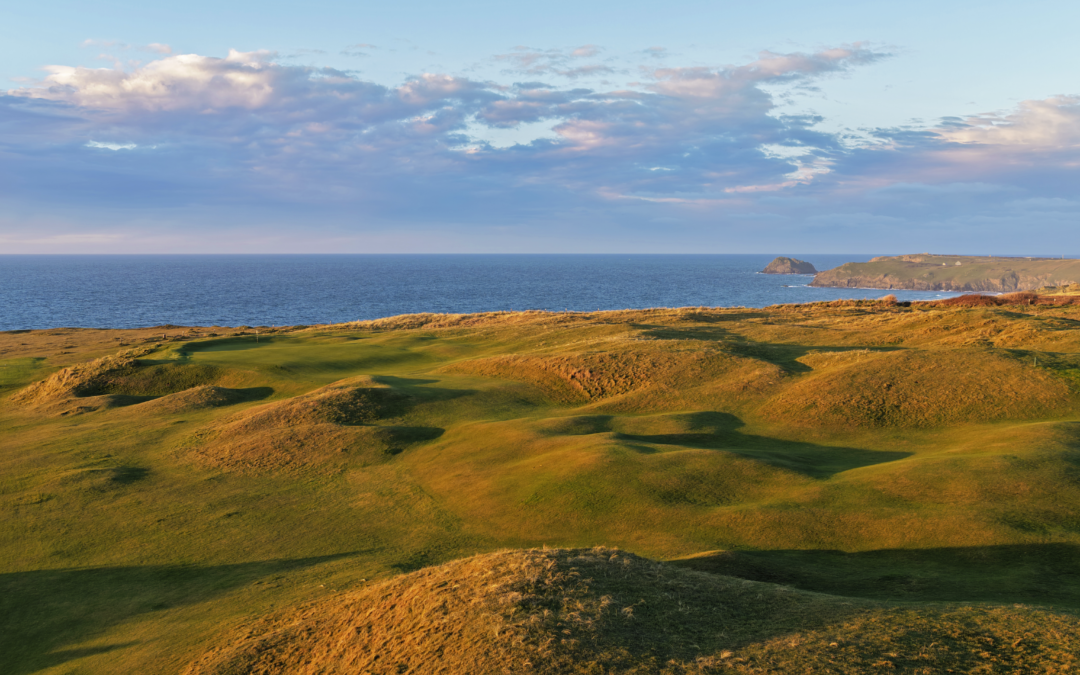
Perranporth does exactly that. Perched high above the Atlantic coastline on the rugged north coast of Cornwall, this James Braid masterpiece is not simply a golf course laid across the land. It feels discovered rather than designed — a links course carved naturally through towering dunes, rumpled fairways, hidden valleys, and windswept ridges overlooking one of the most spectacular beaches in Britain.
From the very first glimpse of the course, you sense this will not be an ordinary round. The Atlantic stretches endlessly beyond the cliffs. Waves roll toward the vast sands of Perran Beach. The salty air carries the distant sound of surf and seabirds. And ahead of you lies a landscape that looks as though golf has been played here for centuries, even though the course only opened in 1927. For golfers seeking authentic links golf in Cornwall, Perranporth may well be the purest expression of the game in the southwest of England.
A James Braid Design You Will Not Forget
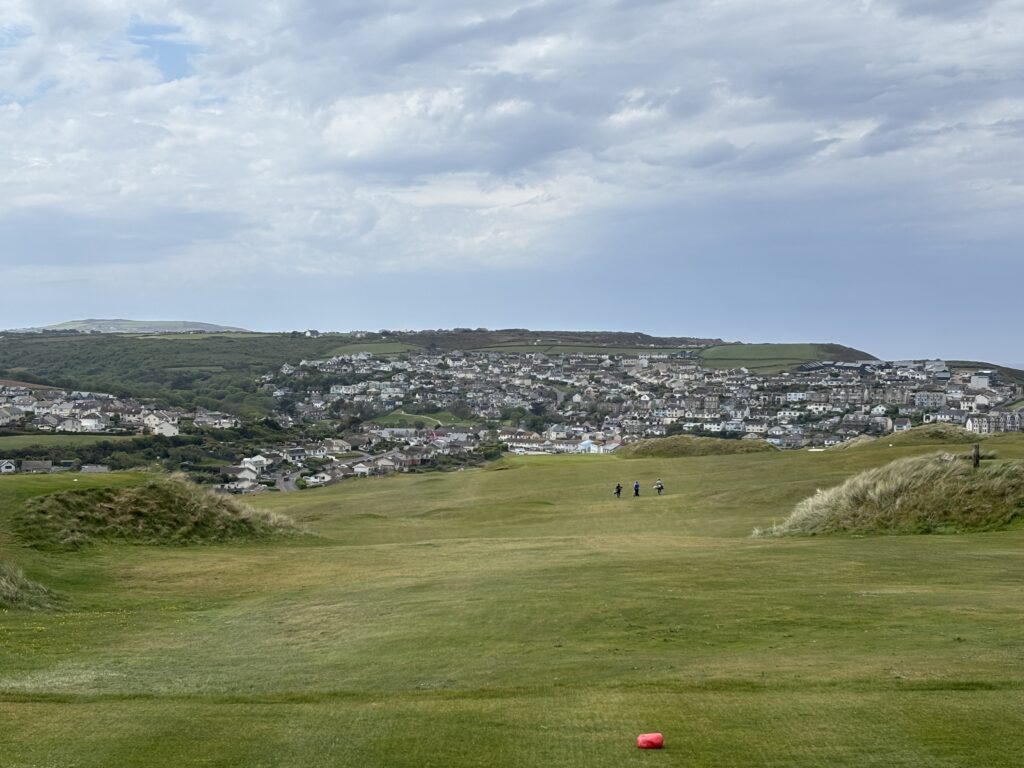
Your tee shot at the first
Five-time Open Champion James Braid designed Perranporth in 1927, and remarkably little has changed since then. That fact alone tells you something important. Modern golf architecture often seeks refinement. Fairways are softened. Blind shots disappear. Hazards become more visible. Courses are engineered to accommodate modern equipment and predictable play.
Perranporth has resisted all of that. Instead, it remains gloriously old-fashioned in the very best sense. Braid used the natural movement of the land exactly as he found it, weaving holes between enormous dunes and over wildly undulating terrain. There are very few artificial bunkers because the landscape itself provides all the defence required.
Blind Faith
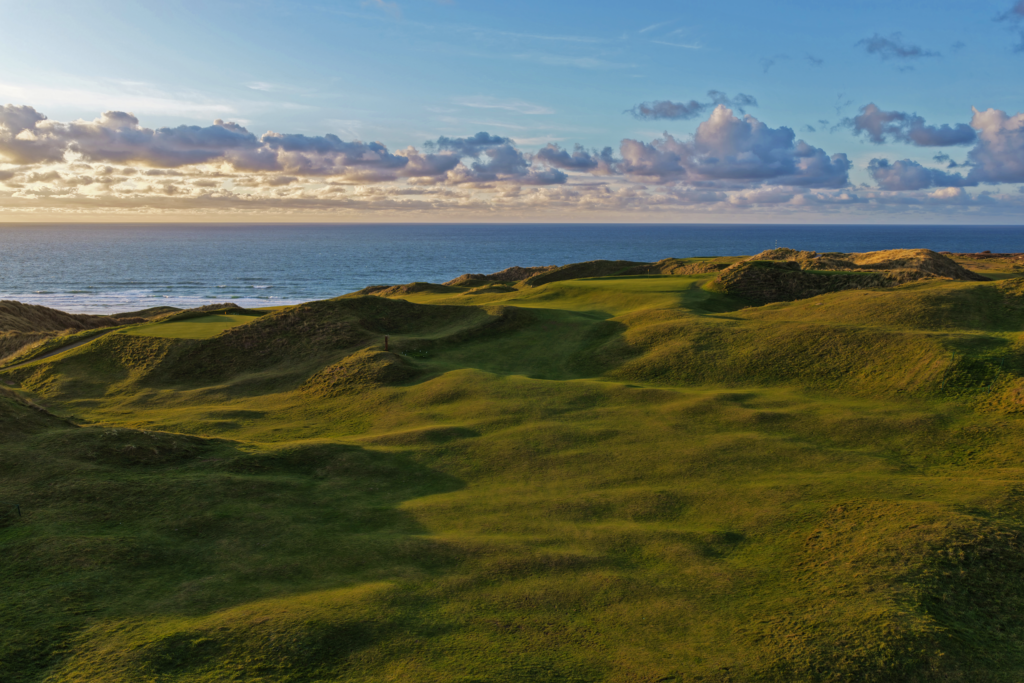
No flat lies here
This is links golf in its rawest form. The fairways bounce unpredictably. Lies are rarely flat. Approaches feed away from greens if struck with the wrong trajectory. And perhaps most famously, there are numerous blind shots — the sort of holes that modern architecture often avoids but which traditional links golfers secretly adore.
Marker poles point toward unseen fairways and hidden greens. You swing partly on instinct and partly on faith. For some golfers, that will feel unsettling. For others, it is pure joy. After decades of playing increasingly manicured courses, I found Perranporth wonderfully refreshing. It forces you to think. To commit. To accept that golf was never meant to be entirely predictable. And that is precisely why it feels so alive.
Blind Shots, Bounces and Beautiful Chaos
Perranporth is not a course you overpower. At just over 6,200 yards from the back tees, it appears modest on paper. But scorecards tell only a fraction of the story here. The real defence lies in the terrain.
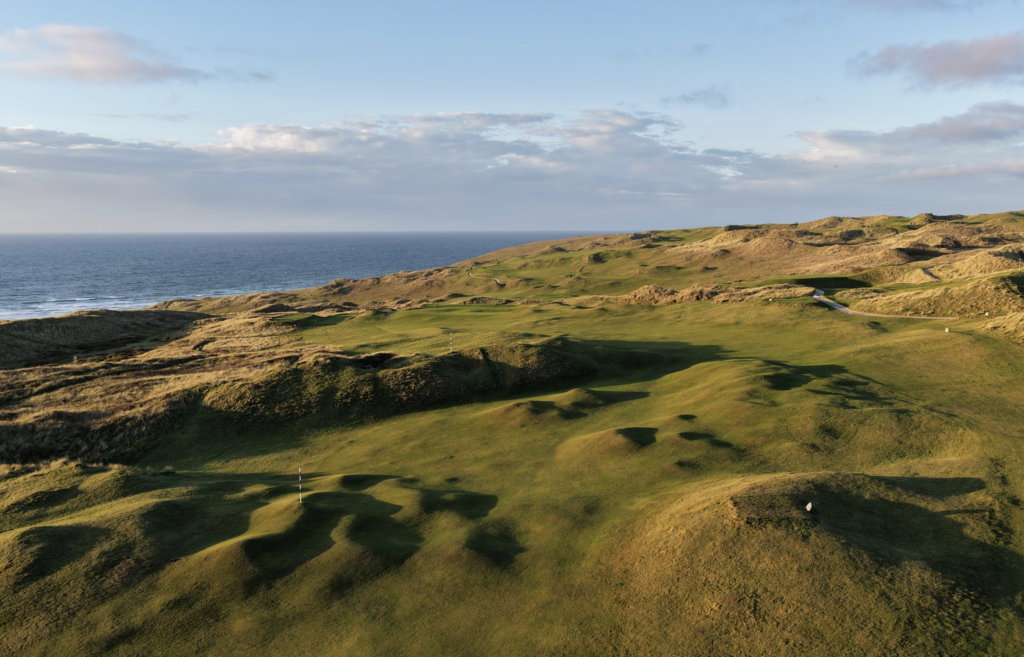
Two marker poles on the 2nd hole
Many of the drives are partially or fully blind, particularly for first-time visitors. The 2nd, is a bruising par-5 where positioning matters far more than distance.
Some modern golfers dislike blind shots because they remove certainty. Personally, I love them. Golf was never intended to be played like target practice. Courses like Perranporth remind you that the game once celebrated mystery and discovery. The hidden fairway over the dune. The approach played against the skyline. The anticipation as you crest a ridge to see where your ball has finished.
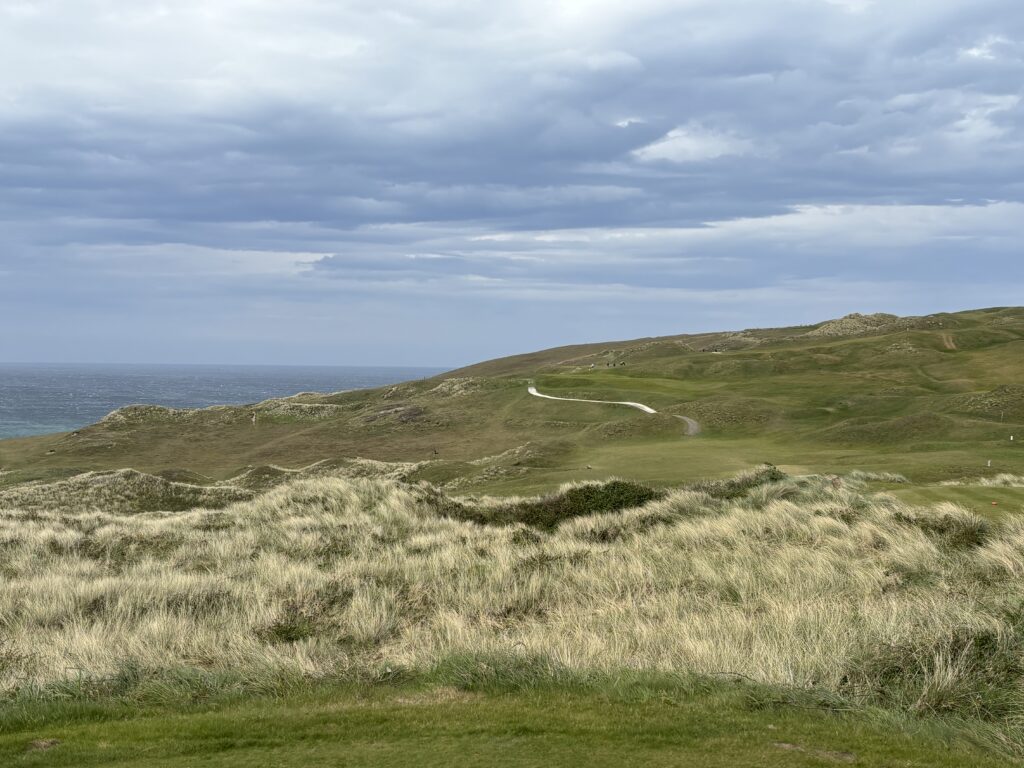
Downhill then uphill on the 3rd hole
A classic Braid design. The drive falls into a natural valley before the approach climbs sharply to a raised green. Distance control is essential, and the change in elevation makes club selection anything but straightforward.
That sense of adventure has largely vanished from modern golf. At Perranporth, it still thrives. And then there are the greens. Raised, firm and wonderfully subtle, they demand imagination on every approach. Balls landing a yard short may roll back twenty feet. Miss in the wrong place and delicate recovery shots become unavoidable. This is not a golf course where autopilot works. Every shot asks a question.
Signature Stretch – Perranporth’s Heartland Holes (11th–16th)
The inward stretch at Perranporth is where the course fully leans into its identity. The dunes tighten, the wind feels more constant, and the sense of isolation grows with every step away from the clubhouse. It is not a gentle return home — it is a succession of questions, each one slightly different in tone but equally uncompromising.
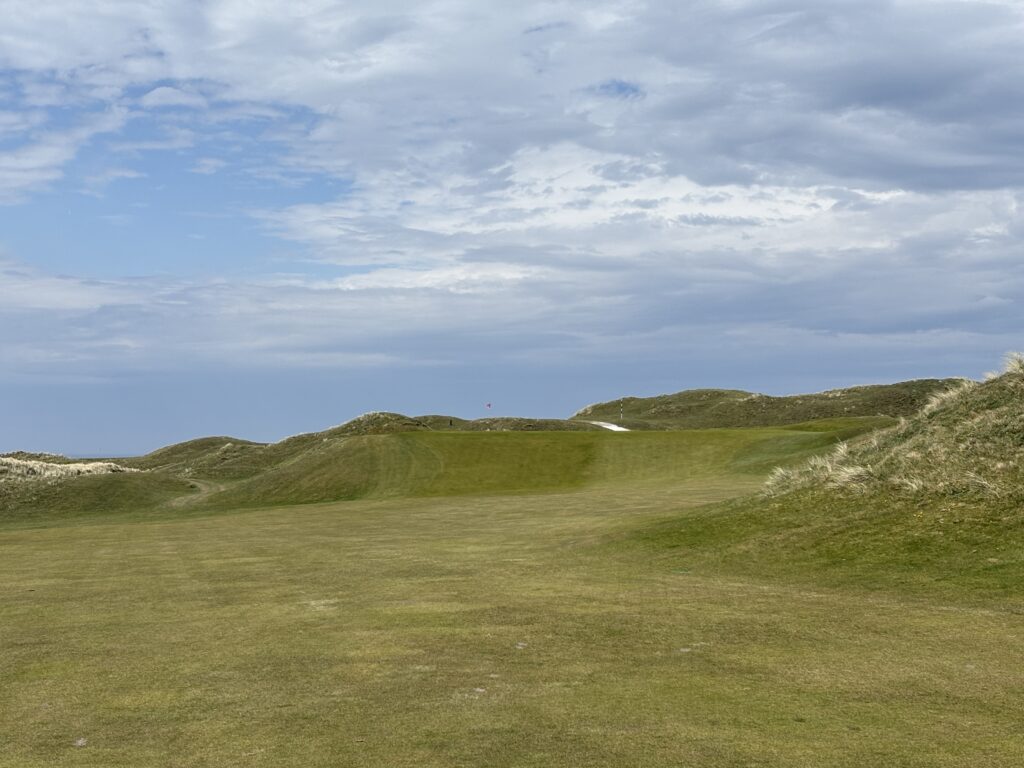
How do you play this shot in the wind?
The 11th, the longest hole on the course at 564 yards, sets the tone immediately. It is a three-shot par five that refuses to offer a single straight line of comfort. The fairway twists through rumpled ground, with dune shoulders repeatedly obscuring both ideal angles and safe misses. The second shot is the real examination — not just for distance, but for commitment to a line you often cannot fully see. Even when you reach the final approach, the green sits elevated and exposed, asking for a precise strike into a surface that rejects hesitation.
Braid’s Best
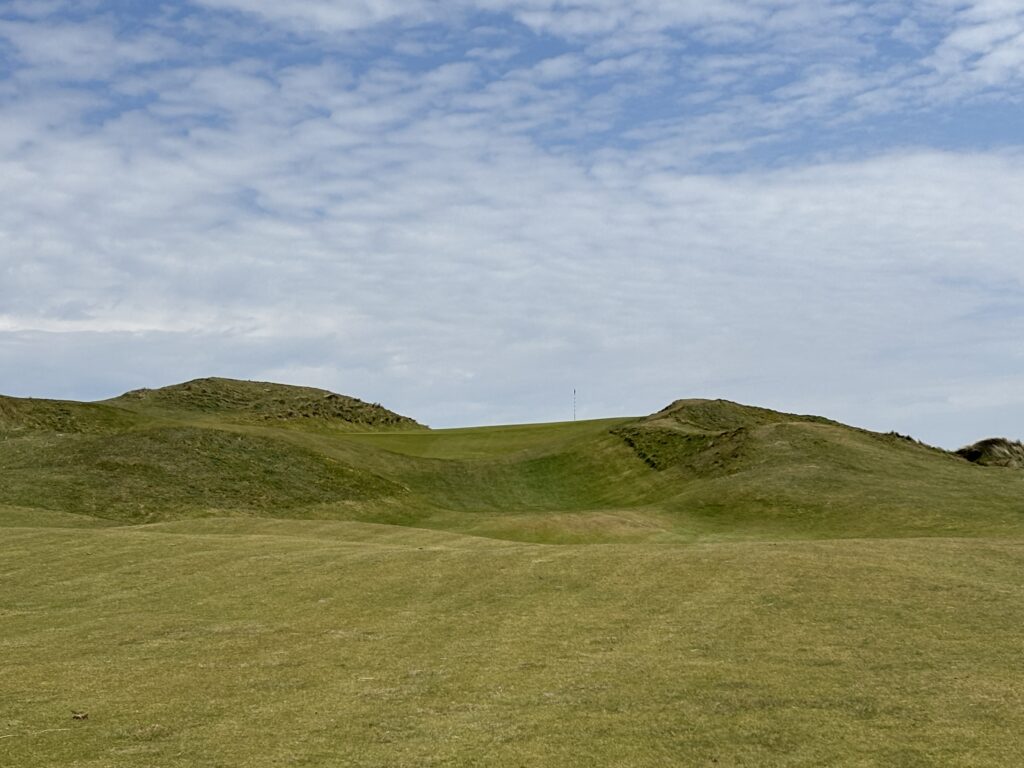
Make sure you get it up to the green
Then comes the celebrated 14th, “Braid’s Best,” a 392-yard par four that looks almost casual until you stand on the tee. It is a hole built entirely on conviction. The fairway tumbles away into natural movement, and the wind here rarely behaves itself. What makes it memorable is not just the setting, but the clarity of demand: pick a line, trust it, and accept the result. The green is sharply defined by its surrounds rather than hazards, meaning anything slightly under-hit or off-angle is quickly gathered into awkward recovery ground. It is short on paper, but absolute in character.
With panoramic views across the Cornish coastline and a sense of total isolation, the 14th is a pure expression of Braid’s design genius—strategic, natural, and utterly memorable.
What a View
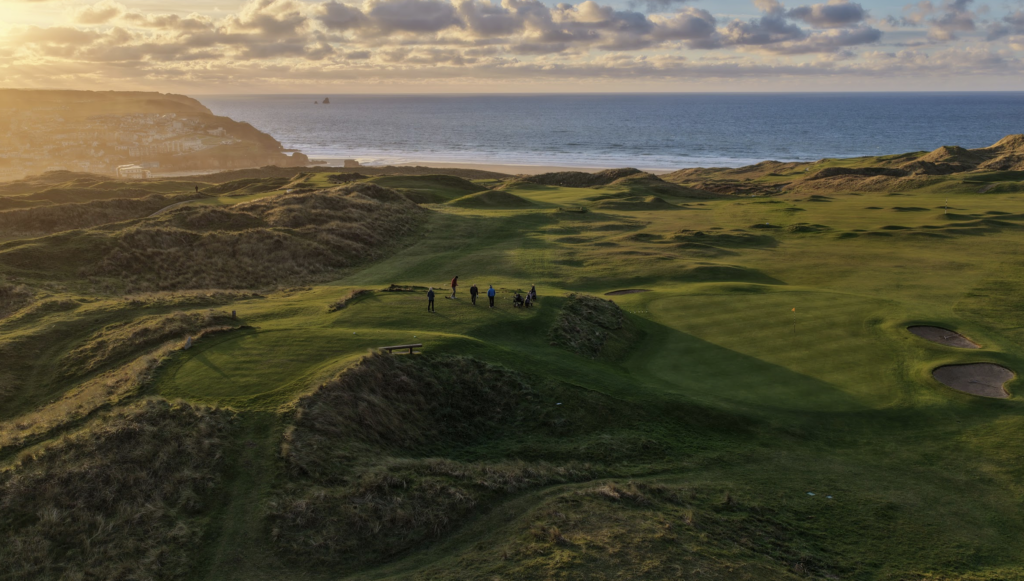
The stunning 16th hole
The 16th, a 209-yard par three, is where the course feels at its most exposed. There is no shelter, no framing comfort — just a long carry into open dune land where the wind dictates everything. The green appears simple from the tee, almost understated, but it is a subtle deception. Its contours are far more demanding than first impressions suggest, and anything missing the putting surface is immediately punished by tightly shaved run-offs that return the ball to uncomfortable positions. It is a hole that rewards commitment to a flight rather than hesitation with club selection.
It is a classic Perranporth test—honest, unadorned, and shaped entirely by the natural land, offering both beauty and real strategic challenge in equal measure.
Cornwall’s Most Dramatic Natural Links Setting
One of the defining features of Perranporth Golf Club is its overwhelming natural drama. This is not simply a golf course beside the sea. The course sits high above the beach, exposed to the Atlantic elements, with panoramic views stretching endlessly along the Cornish coastline and inland toward rolling countryside dotted with farms and stone cottages.
The course is one of the most extraordinary I have encountered anywhere in Britain. The landscape is irregular, rugged, and completely natural. Some holes tumble between them in narrow corridors, while others climb onto elevated plateaus where the wind suddenly becomes a major factor.
On calm days, Perranporth is enchanting. Under heavy Atlantic winds, like the day we played, it becomes something altogether different. The breeze shifts constantly through the dunes. A shot that feels perfectly struck can suddenly drift twenty yards offline. Club selection becomes an exercise in imagination rather than mathematics.
And yet this unpredictability is exactly what makes the course so compelling. The turf is firm and fast, true links ground that encourages the ball to run endlessly along the contours. Low punch shots become essential. Creativity is rewarded far more than brute strength.
For travelling golfers searching for scenic golf courses in Cornwall, few places can match Perranporth’s visual impact. Every elevated tee reveals another cinematic view of sea, sky, dune and cliff. There are moments during the round when you stop thinking about golf entirely. You simply stand still and admire where you are.
Why Travelling Golfers Should Play Perranporth
For the travelling golfer, Perranporth is not about perfection. It is about personality. It offers something increasingly rare in modern golf: uncertainty. Every round feels different very hole asks slightly different questions depending on the wind direction, the firmness of the turf, and the bounce of the ball. Every shot invites imagination.
You cannot simply stand on tees and repeat the same swing eighteen times. Perranporth demands adaptability. That is why the course leaves such a lasting impression. I have played many famous layouts over the decades — Open venues, championship resorts, immaculate modern courses sculpted to perfection. Yet some of those rounds fade quickly from memory because they feel controlled and predictable.
Perranporth is unforgettable because it feels untamed. There is a wonderful honesty about the place. It does not flatter poor golf, nor does it apologise for its eccentricities. Instead, it embraces them completely. And the golfing world is richer for that. For those planning a golf trip to Cornwall, Perranporth deserves to sit high on the itinerary alongside the county’s better-known names. Indeed, many golfers now consider it one of the finest value links experiences in Britain.
Final Thoughts: Imagination Over Power
The truth about Perranporth Golf Club is wonderfully simple. It does not try to be easy. It does not try to be modern. And it certainly does not try to be ordinary. Instead, it asks you to adapt. It challenges how you think about golf more than how far you hit the ball. It rewards patience, punishes assumption, and celebrates creativity in all its forms. And perhaps that is why, after more than fifty years of playing this maddening and magnificent game, courses like Perranporth resonate more deeply than ever.
Because golf was never meant to be perfect. It was meant to be an adventure. Standing on the cliffs above Perranporth Beach with the Atlantic wind pressing against your back, you understand that instinctively. You realise this is not merely a round of golf measured by scorecards or statistics. It is an encounter with landscape, weather, imagination and history. And when the final hole is complete and you take one last look across the dunes toward the endless Cornish sea, you realise something important. You have not simply played a golf course. You have navigated a landscape.
More Than Golf: The Spirit of Cornwall
The town of Perranporth itself has an easygoing surf-town atmosphere. Cafés spill onto narrow streets. The beach stretches for miles. Even in summer, there is a sense of openness and space that feels increasingly rare in modern Britain. You can spend the morning walking the South West Coast Path, the afternoon battling the winds at Perranporth Golf Club, and the evening watching the sunset disappear into the Atlantic from a beachfront pub.
That combination makes this one of the finest golf travel experiences in southwest England. And unlike many famous coastal courses, Perranporth still retains an unpretentious charm. There is no sense of exclusivity or manufactured luxury here. Just authentic links golf beside one of Britain’s great beaches.
All aerial photos courtesy of Perranporth Golf Club. Thank you to Nathan Gilpin, the Club’s General Manager for hosting us.
At a Glance:
- An unforgettable 18 hole cliff top links course
- This course will test your imagination and ball striking
- Lovely clubhouse with welcoming staff
- Well stocked professionals shop
- Fantastic beach and surfer vibe in Perranporth
- Courses nearby: Newquay Golf Club, Trevose Golf and Country Club, St. Enodoc Golf Club and The Point at Polzeath
- View the Perranporth Golf Club website here
- Visit the Golf South West website here

Jim Callaghan CCM is a former Club Manager with experience of overseeing several top Scottish Golf Clubs.
Now, as European Editor of Golf Operator Magazine and World’s Best Golf Destinations, he shares insights into club operations and his golfing adventures across Europe.
Jim is also an Ambassador for premium clothing brand Fenix Xcell Clothing and also for the Spanish local DMC, Costa Verde Golf and is host of @JimTheSeniorGolfer on YouTube.
If your club/resort or brand wants to reach over 450,000 golfers, contact Jim at [email protected] or call 0044 (0) 78522 88732
Featured Post

 0
0