There is a particular kind of arrogance that walks onto a golf course under 5,100 yards. It struts. It has already mentally signed for a 68. And it has, in its head, already told the story of the birdies it hasn’t made yet. And there is a particular kind of golf course, tucked along the north Dublin coastline on the same stretch of linksland as the world-famous Island Golf Club, that exists purely to strip that arrogance away, one impossible little par 4 at a time. That course is Corballis Links, and it does not care how many yards are on your scorecard. It only cares whether you can find your ball again.
This is not a course that announces itself with grandeur. There is no sweeping clubhouse drive, no marble entrance, no hushed reverence in the car park. Corballis is a municipal links, open to anyone willing to pay the fee and take the beating, and that is precisely the point. It asks nothing of your wallet and everything of your golf.
A Century in the Dunes
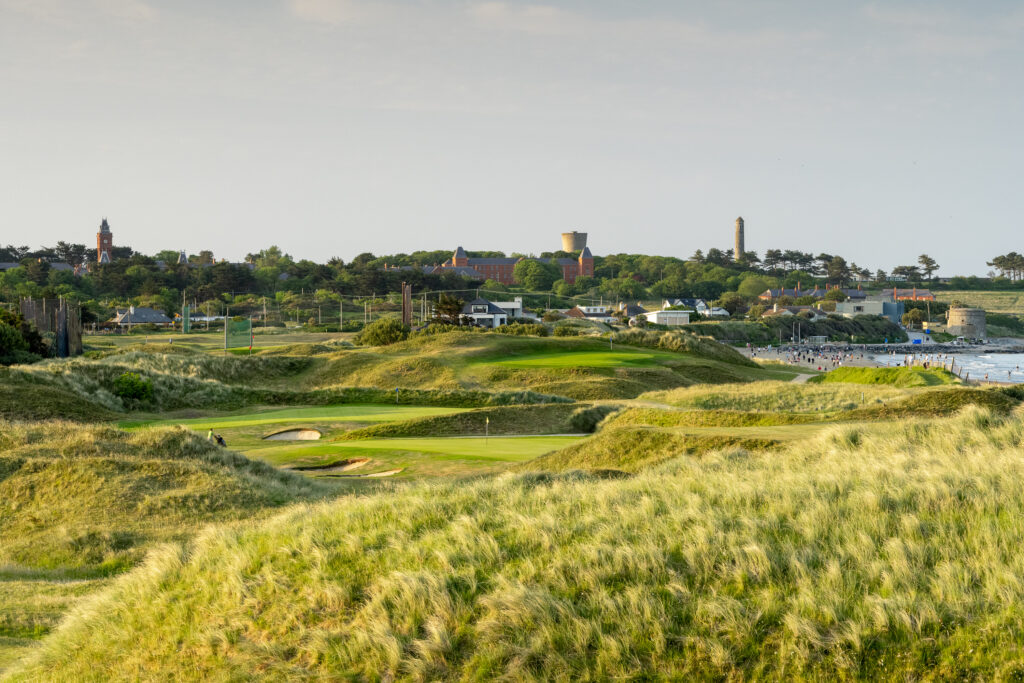
The 1st, 12th and 13th greens
Corballis carries more history in its turf than its modest reputation might suggest. The original course first opened in 1906, a full century before most golfers ever heard its name whispered in a clubhouse bar. It was completely rebuilt in 1971 when Fingal County Council took the course under its wing, and Corballis Links Golf Club as it exists today was founded the following year, in 1972. For decades it quietly earned its keep as one of the finest pay-and-play facilities in Ireland — unglamorous, unpretentious, and unshakeably good.
Then, in October 2007, the course architect Ron Kirby was brought in to reshape the front nine, weaving four new holes directly along the coastline. What emerged from that work is the version of Corballis played today — a par-66 links that trades length for something far more interesting: relentless, inventive, occasionally maddening variety. Don’t let the number on the scorecard fool you. This is not an easy day out. It is a puzzle disguised as a short course, and it will find every weakness in your game that a longer, gentler layout would have politely ignored.
A Course Built on Deception
Looking at the card before you tee off, it is tempting to start doing the arithmetic of a low round. Short par 3s. Short par 4s. Surely there are birdies everywhere. That arithmetic collapses almost immediately, because Corballis does not play the way its numbers suggest. This is a course built entirely on optical illusion — fairways that vanish before you can see the green, greens too small to forgive anything but a perfect strike, and dunes that swallow anything hit even slightly off the intended line. If you finish your round with the same ball you started with, you have not just played well. You have been shown genuine mercy.
The Front Nine — Small Targets, Big Trouble
The front nine at Corballis specialises in a very particular cruelty: it makes a short hole feel like the hardest shot of your life, simply by refusing to show you where you’re supposed to hit it.
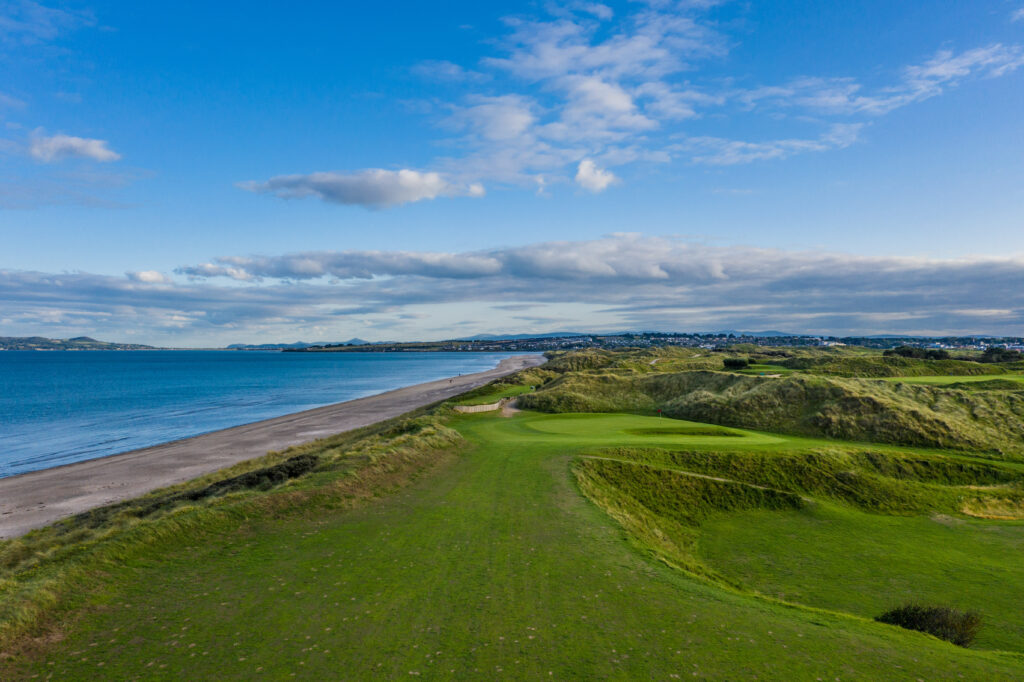
The 2nd green
The 2nd hole is barely a par 4 in length, and yet it plays like something conjured to punish overconfidence. The temptation off the tee is to have a go at the green — resist it entirely. There is virtually no fairway to speak of past 160 yards, just a sliver of grass no wider than a couple of golf buggies parked side by side, with a gully waiting beyond it to swallow anything ambitious. A mid-iron off the tee, played safely short, is not caution here — it is the only sane strategy the hole allows. Even then, the green that awaits is tiny, unwilling to receive anything but the truest of pitches.
Short But Mighty
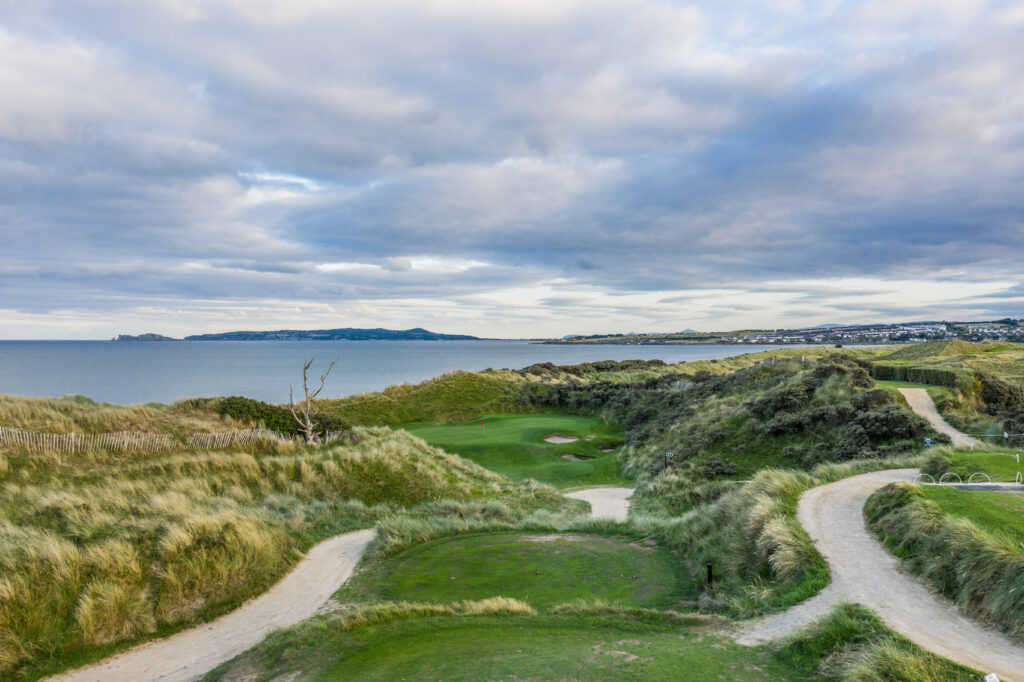
The 6th hole
Just as deceptive, in a different key, is the 6th. It’s barely a hundred yards long and dressed up as the easiest hole on the property. It is nothing of the sort. A pot bunker lurks in wait for anything played straight at the flag or fractionally right of it, ready to turn a seemingly perfect tee shot into two extra strokes before you’ve even reached the green. The hole rewards restraint over ambition; the smart line plays left of the pin, sacrificing a close birdie look for the safety of a two-putt par. Underestimate it, and it will make a fool of you in the gentlest, most polite way imaginable.
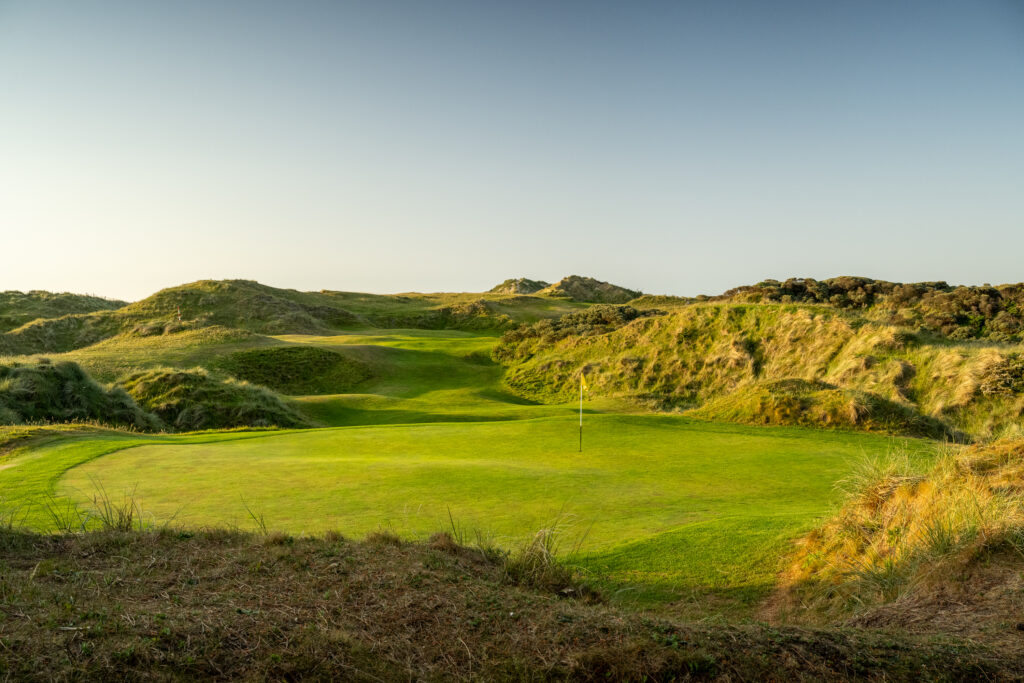
Looking back up the 7th hole
The 7th continues the theme with a second sub-250-yard par 4 that hides its green behind dunes entirely. From the tee, only a thin strip of fairway is visible. The true line, the aggressive, tempting line over the dunes to the left. This should be avoided by anyone who wishes to see their ball again. The percentage play is the same conservative iron off the tee, landing on the visible fairway, leaving a short wedge up to a tiny, raised green. It is another hole engineered to punish exactly the kind of golfer who assumes a short course means an easy one.
The Back Nine — Where the Sea Takes Its Due
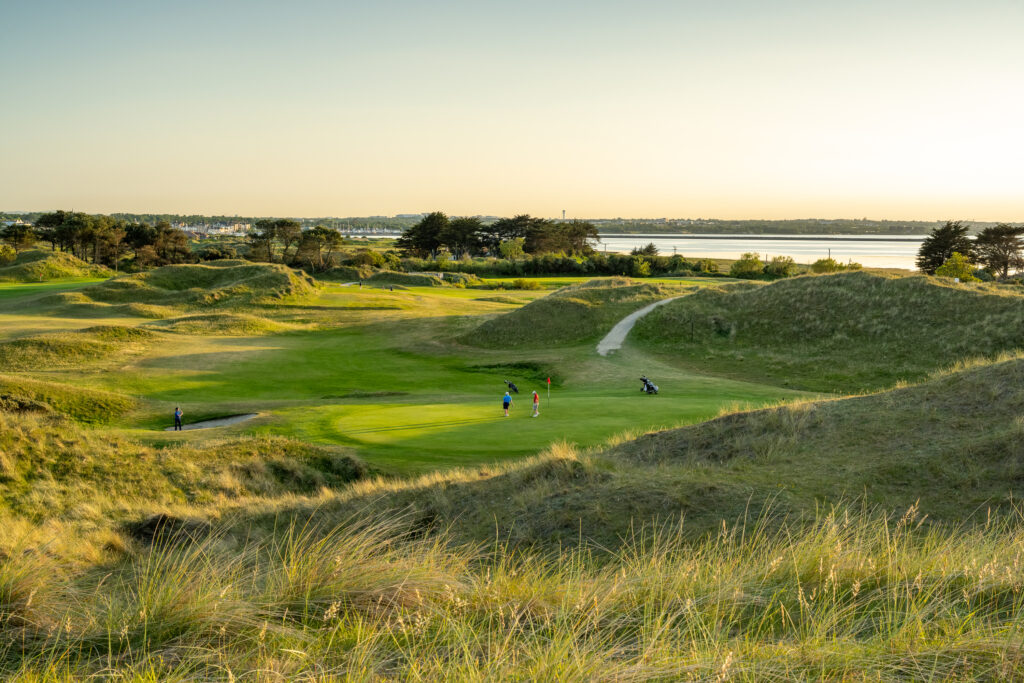
Looking back up the 10th hole
If the front nine deceives with distance, the back nine deceives with reputation. Nowhere is that clearer than at the 10th, officially the easiest hole on the course by stroke index, and officially one of the most misleading labels in Irish golf. At 178 yards, it is the longest par 3 on the property. In any kind of crosswind off the coast, it plays every inch of that distance and more. A well-struck iron can come up agonisingly short, leaving nothing simple about the up-and-down that follows. The stroke index says easy. The wind says otherwise.
The Only Par Five
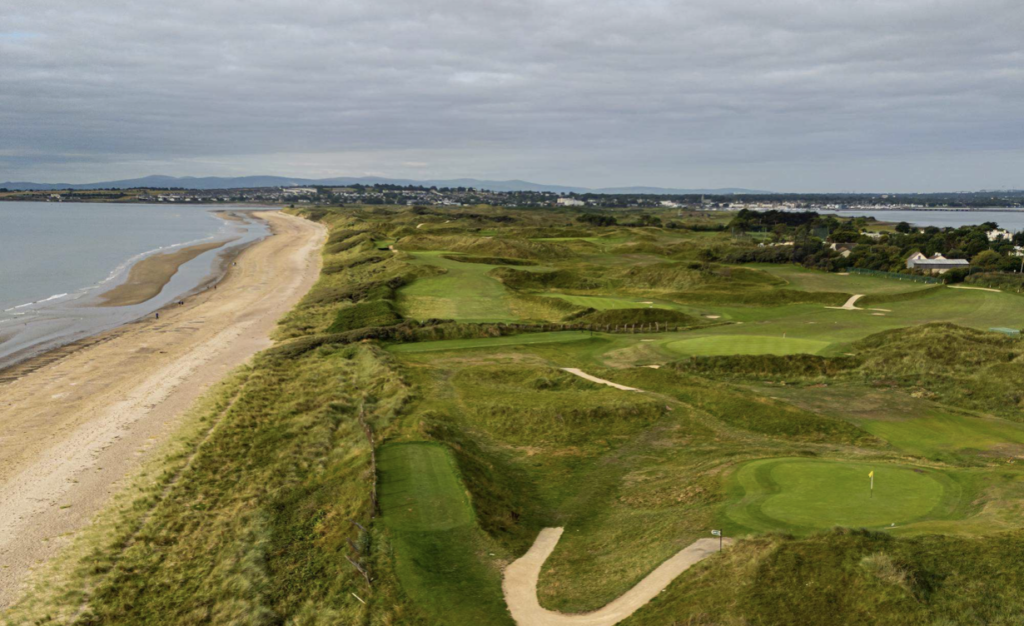
The 12th and 13th holes
The 12th offers a rare change of pace, Corballis’ one true three-shot hole. A par 5 of modest length that crosses paths with the first hole, meaning patience is required even before you swing. A long drive down the left is the only route to a clear look at your second shot. Anything shorter, and the smart play becomes a simple lay-up followed by a pitch-and-putt chance at birdie. It is, by Corballis standards, almost generous.
And then there is the 13th, which returns the course to its favourite trick: a tiny target perched just out of reach. At only 133 yards, it should be the easiest thing in the world. However, the green sits above the tee with no bailout anywhere in sight. It slopes cruelly from back to front and right to left. Miss even slightly long, and you are left staring up a slope with almost no shot that offers a realistic look at par. It is a hole that asks you to accept failure gracefully. Then, every so often, rewards that acceptance with an entirely undeserved putt that finds its way home anyway. Links golf, in its most poetic and most maddening form.
More Than the Sum of Its Yardage
Golfers arrive at Corballis expecting a novelty and leave talking about it like a genuine test. That reaction is not an accident. The club has spent real effort making sure the experience matches the land it sits on. It keeps the presentation sharp and the course playable through every season. A round here never feels like a lesser cousin to the grander links up the road. There is no pretension in the clubhouse, no sense that you need a member’s introduction to belong. Just a warm welcome, a genuine interest in how your round went, and very often a knowing smile when you admit which hole finally beat you. Ask anyone who works there, and they will tell you the same thing with a grin: everybody underestimates Corballis exactly once.
The Verdict
There is something genuinely rare about a golf course that refuses to be judged by its length. Corballis Links proves, hole after hole, that difficulty was never really about yardage. It was always about angles, about wind, about small greens that demand precision rather than power. The fairways here run firm and fast, browned by salt air and constant wind, while the greens stay true beneath all that visual chaos. It is, in the truest sense, links golf distilled to its essence: fun, painful, occasionally absurd, and utterly unforgettable.
At barely over 5,000 yards from the tips, Corballis will never intimidate anyone on paper. It does not need to. It will do all its intimidating in person, one impossible little approach shot at a time. And somewhere around the 7th or 8th hole, as you search yet again through the dunes for a ball that vanished off a perfectly reasonable-looking shot, you will understand exactly why this small, unassuming municipal course has quietly become one of the most talked-about rounds in Irish golf. You will not find another 18-hole links course this short, this affordable, or this capable of humbling you in quite so many different ways. And you will not want to.
At a Glance
- Location: 20 minutes drive, north east of Dublin Airport
- Par-66 links course, originally opened in 1906, rebuilt in 1971 and re-founded as Corballis Links Golf Club in 1972
- Four new coastal holes on the front nine designed by architect Ron Kirby, added in October 2007
- Championship length just over 5,000 yards, one of the shortest full 18-hole links courses in the country
- Green fees around €30 midweek, €35 at weekends
- Owned and operated under the Carr Golf group
- Courses Nearby: The Island Golf Club, Portmarnock Golf Club, Portmarnock Resort & Jameson Golf Links
- For more information, visit the Corballis Links website
Thank you to Karl Wolahan at Carr Golf for the photos used in this article.

Jim Callaghan CCM is a former Club Manager with experience of overseeing several top Scottish Golf Clubs.
Now, as European Editor of Golf Operator Magazine and World’s Best Golf Destinations, he shares insights into club operations and his golfing adventures across Europe.
Jim is also an Ambassador for premium clothing brand Fenix Xcell Clothing and also for the Spanish local DMC, Costa Verde Golf and is host of @JimTheSeniorGolfer on YouTube.
If your club/resort or brand wants to reach over 450,000 golfers, contact Jim at [email protected] or call 0044 (0) 78522 88732
Featured Post

 0
0